Schedule
HostsWays to Give
HomePlaylistSchedule
HostsEventsOn DemandOur StoryOur TeamWays to Give Become a Sponsor
How to ListenVisit Help CenterContact Us

Find Us on Social Media:

Logo image

Find Us on Social Media:

Download Our Mobile App:

google play icon

About

HomePlaylistSchedule
HostsOn DemandOur StoryOur Team

Community

EventsWays to Give Become a SponsorPressDiversity StatementCareersAnnual EEO ReportDigital Accessibility

Help

How to ListenVisit Help CenterContact Us

©2025 Classical California

Sweepstakes RulesFCC ComplianceLocal Public FilesCPB ComplianceAnnual EEO ReportPrivacy PolicyCode of Integrity

articles / Pop Culture

Beware the Waltz

Pop CultureWaltz


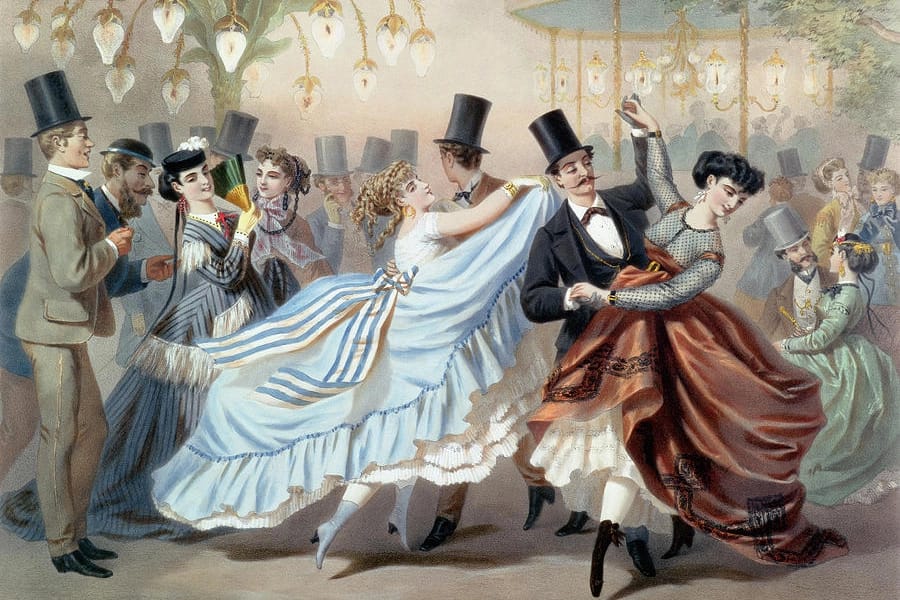
It’s elegant, it’s graceful, and 200 years ago it was the subject of some pretty serious warnings.

By the 1790’s the waltz was all the rage. And along with its immense popularity came red flags. There were medical concerns because of the speed with which the dancers moved around the room. And there were moral objections because of the closeness of the partners.

The Lexicon of Musical Invective, an English encyclopedia of 1805, described the waltz as “a riotous German dance of modern invention. Having seen it performed by a select party of foreigners, we could not help reflecting how uneasy an English mother would be to see her daughter so familiarly treated, and still more to witness the obliging manner in which the freedom is returned by the females.”

In 1816, however, an English dancing master named Thomas Wilson came to the dance’s defense. Said Mr. Wilson, “The waltz is not an enemy to true morals. It is generally admitted to be a promoter of vigorous health and productive of a hilarity of spirits.”

And if you’d like to read Lord Byron’s poetic appraisal (published anonymously in 1813), look here.

Pop CultureWaltz
Written by:
Alan Chapman
Alan Chapman
Published on 09.08.2017
Loading...

MORE LIKE THIS

Sharing the Love of Music with Children

Sharing the Love of Music with Children

"Explore the Baltimore Symphony's OrchKids program, founded by Marin Alsop, aiming to diversify concert halls and inspire young musicians."

06/10/2018
In Praise of the Violin

In Praise of the Violin

This article traces the history of the violin from its 16th-century Italian origins, through its evolution in playing techniques, to its role in classical music. It also explores its unique construction.

05/09/2018
Ping Pong on the Concert Stage

Ping Pong on the Concert Stage

Explore how a visit to Spin, a trendy Ping-Pong club in NYC, inspired composer Andy Akiho to create his piece Ricochet, performed by the New York Philharmonic.

02/26/2018
The Olympic Theme Explained

The Olympic Theme Explained

Explore the history and structure of the NBC Olympic Theme, composed by John Williams for the 1984 LA Olympics, and discover a unique rendition of this iconic tune.

02/15/2018
The Ophi-What?

The Ophi-What?

Explore the history of the ophicleide, a 19th-century instrument used in orchestras and military bands, famously included in works by Berlioz, Mendelssohn, Verdi, and Wagner.

11/16/2017
Playing the Oldies

Playing the Oldies

Explore the unique sound of period instruments in Baroque music with Trevor Pinnock and The English Concert, and compare it to modern instrument performances.

08/22/2017