articles / Hosts
Twentieth Century Topics: Switching Gears
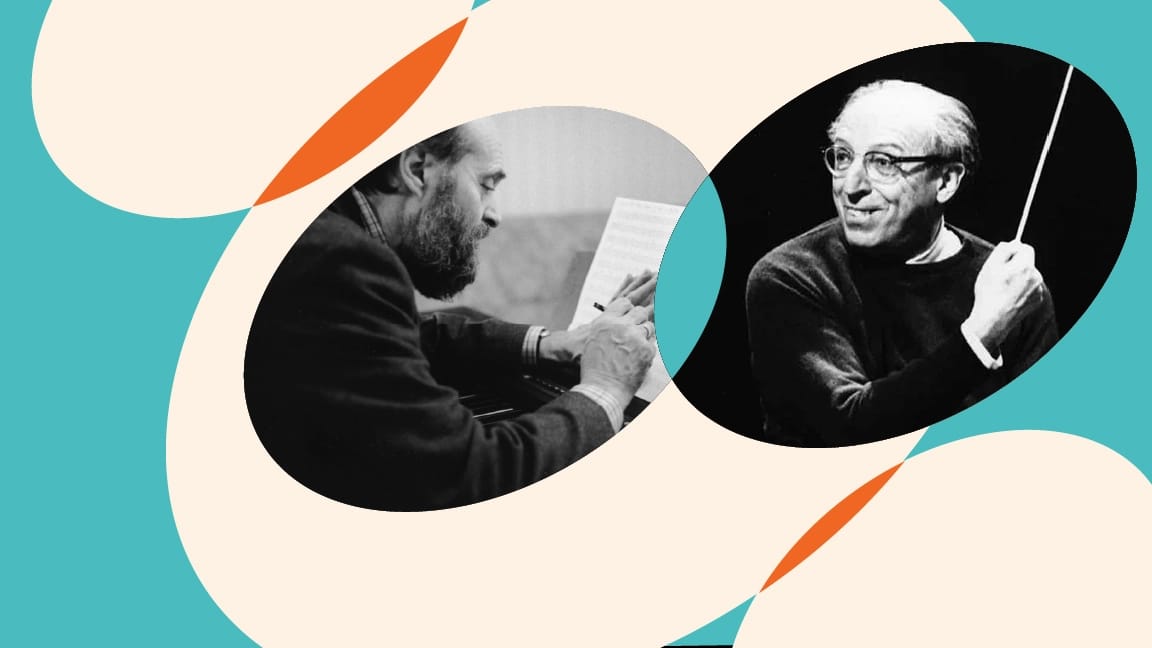
It’s not unusual for a composer’s musical style to evolve over time. We’re going to take a look at two twentieth-century composers who made a specific decision to transform their styles, that is, to switch gears.
Let’s start with a popular piece by Copland, Hoedown from the ballet Rodeo. Copland himself introduces the music and conducts.
Copland is more than a composer. He’s a personification of American music. Conductor André Previn put it this way:
Aaron Copland is such a towering figure in twentieth-century music that he has become synonymous with American music. Time and time again, when my colleagues and I are asked for the inclusion of an American work in a concert (particularly in Europe), what the presenters are actually requesting is a work of Copland’s.
Rodeo (from 1942) is the Copland we know and love, but what do we find when we go back two decades? At the age of 20 Copland went to Paris and over the next three years he studied with the most celebrated composition teacher of the century, Nadia Boulanger. Many other American composers followed. The composer Virgil Thomson said that every small town in America had two things: a five-and-dime store and a Boulanger student.
Copland described Boulanger as a “powerful” teacher, an “exhilarating” teacher. She in turn had a great deal of confidence in Copland and commissioned him to write a symphony for organ and orchestra that she would play on her first American tour. That work was premiered in New York in January of 1925 with Walter Damrosch conducting. Listen to a bit of it (start at 16:50).
At the conclusion of the performance maestro Damrosch turned to the audience and said:
If a young man at the age of twenty-three can write a symphony like that, in five years he will be ready to commit murder.
This is clearly not the Copland we know and love, so how did he become the Copland we know and love? It didn’t happen overnight. In 1932 he was revising his ballet Grohg, inspired by a silent movie he had seen in Paris, the vampire film Nosferatu (start at 1:06).
Still not the Copland we know and love, but a change was on the way. It was in the early 1930s that Copland became concerned with the relationship between the composer and the public. He explained it this way: “I began to feel an increasing dissatisfaction with the relations of the music-loving public and the living composer...It seemed to me that we composers were in danger of working in a vacuum...I felt that it was worth the effort to see if I couldn’t say what I had to say in the simplest possible terms.”
So Copland switched gears and began to work within what he called “imposed simplicity” or his “vernacular style.” His first work in this new style was inspired by a visit to a Mexico City dance hall four years earlier. That work is Copland’s El Salón México.
Copland’s change of style was the gateway to three very popular ballets, Billy the Kid, Rodeo, and the Pulitzer Prize-winning Appalachian Spring.
Right at the beginning of Appalachian Spring we hear the essence of Copland’s vernacular style.
Just as Copland simplified his style in the 1930s, Arvo Pärt did the same in the 1970s.
Pärt was born in 1935, but the scholarly music journals, the publications that are first to take note of new music, only started to talk about him in the early 1980s. Part of the explanation is geographical. Pärt was born in Estonia. In 1957, at age 22, he became a sound engineer for Estonian radio. In 1963 he graduated from the conservatory, but remained with Estonian radio until 1968. By that time he was well known in Russia and could earn a living as a composer, but his refusal to join the Communist Party led to a growing inattention toward his work.
In 1980 Pärt gave up his Soviet citizenship and emigrated to Vienna; in 1981 he settled in Berlin. In 1984 the German recording company ECM released a recording of his works which became a best seller. In a 1988 interview Pärt was asked whether he considered himself an international composer. He replied, “I’m known here as a Russian composer, though I’m not Russian at all. I am an Estonian who has Austrian documents and lives in West Berlin—I am sufficiently enough international!”
In 1966 you could find Pärt composing music like this:
At the time Pärt was a composer of twelve-tone music, the modernist idiom pioneered by Arnold Schoenberg in the 1920s. This did not exactly endear him to Soviet officialdom.
But Pärt said, “I wasn’t alone with my twelve-tone music for long. One day, the composer-officials had adopted the twelve-tone technique, partially at least. And when about 90% of them were twelve-tone, I created my new style and was declared mad for the second time.”
By the mid-'70s he arrived at a new style he called "tintinnabulation," a word that means the sound of bells ringing. Like Copland he adopted a simpler style out of an artistic need. Pärt explains, "I work with very few elements - with one voice, with two voices. I build with the most primitive materials - with the triad, with one specific tonality. The three notes of a triad are like bells. And that is why I called it tintinnabulation." Speaking of the simplicity of his musical materials Pärt said, “It’s enough to play just one note beautifully.”
From 1978, Pärt’s Spiegel im Spiegel (Mirror in the Mirror).